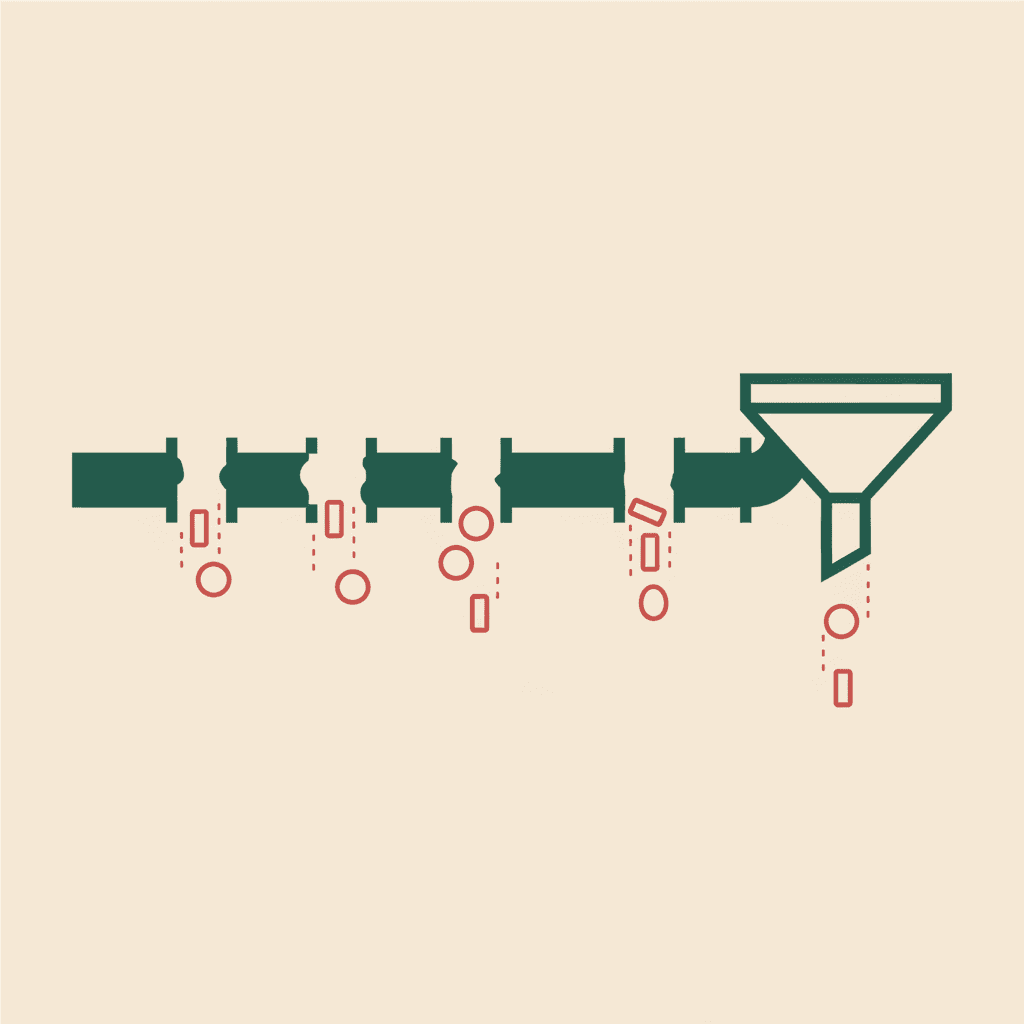
The billing-to-collections gap is the difference between what a healthcare clinic is entitled to collect under its payer contracts and what it actually banks — typically running 12–18% at multi-location outpatient practices — representing revenue lost to denials, underpayments, write-offs, and uncollected patient balances.
The denominator matters, and most articles on this get it wrong. The gap is not gross charges minus collections. Gross charges are set by your chargemaster and bear little relation to what any payer has agreed to pay; the difference between them is the contractual adjustment, and it is normal, expected, and not lost money. A practice that bills $500K in charges against contracts worth $300K and collects $290K has not lost 42%. It has lost 3.3% of what it was owed.
So the metric is:
Expected collectible revenue = gross charges − contractual adjustments The gap = (expected collectible − actual collections) ÷ expected collectible
That is the number worth chasing, because every dollar in it was contractually yours.
$600K to $900K per year
This post is about the 12–18% gap and the 5 places it hides. If your billing team says everything is fine, start with billing-team-says-everything-is-fine.
Based on the practices we have reviewed, at a $5M multi-location clinic, 12-18% of revenue disappears between what gets billed and what actually hits the bank account.
That is $600K to $900K per year.
Not lost to bad debt. Not lost to low patient volume. Lost in the space between billing a claim and collecting the cash. Lost in timing gaps, process failures, and numbers that nobody reconciles.
If you run a single-location practice doing $1.5M, the math still hurts: $180K to $270K per year. Enough to fund a full-time provider. Enough to change your take-home pay dramatically.
Where does all that money go?
The five places money disappears
We have audited dozens of clinic revenue cycles. The same five leaks show up every time, in roughly the same order of magnitude.
1. Slow claim submission
The clock starts ticking the moment a patient walks out of your office. Every day between the date of service and the date the claim is submitted is a day your cash is delayed. But delay is not the only problem.
Some claims never get submitted at all. They get stuck in a coding queue. The provider did not finish the note. The front desk entered the insurance wrong. The claim needs a modifier that nobody added. It sits in a "hold" bucket in the billing system.
We see clinics with 5-15 days of average lag between date of service and claim submission. At high-volume practices, that represents tens of thousands of dollars in claims that have not even entered the payment pipeline.
2. Incorrect contractual adjustments
When a payer sends a payment, the difference between your billed charge and the allowed amount gets written off as a contractual adjustment. This is normal. Your fee schedule says $200, the contract says the payer pays $140, you write off $60.
The problem is when the adjustment is wrong. The payer sends $120 instead of $140, and the adjustment is automatically posted as $80. Nobody checks whether that $120 matched the contracted rate. The billing system accepts the payment, posts the adjustment, and moves on.
Across hundreds of claims per month, incorrect adjustments add up fast. We routinely find $2K-$8K per month in underpayments that were accepted without question at a single location. Across multiple locations, it compounds.
3. Denied claims that die in a pile
I wrote about this in detail in my previous post on denied claims. The short version: industry sources commonly cite that roughly 65% of denied claims are never resubmitted, representing significant unrealized revenue. At a $5M practice with a 10% denial rate, that is $325K in claims that were denied and abandoned.
The denial itself is not always the problem. The problem is the absence of a process to work denials systematically. Claims get denied, they sit in a queue, they age past timely filing limits, and the revenue is gone.
4. Underpayments nobody catches
This is different from incorrect contractual adjustments. Underpayments happen when a payer simply pays less than the contracted rate, and nobody notices.
Your contract with a payer says they will pay $185 for a specific CPT code. They send $160. The payment gets posted. The balance gets adjusted. Nobody compares the payment to the fee schedule. That silent underpayment is exactly what first-pass resolution rate tracking catches.
To catch underpayments, you need two things: access to your payer contracts with the actual fee schedules, and a process for comparing payments against those schedules. Most clinics have the contracts filed away somewhere but have never built the comparison into their billing workflow.
We find underpayments in every practice we audit. The amounts vary, but $3K-$10K per month per location is common for mid-size clinics.
5. Missed charges
Services rendered but never billed. This is the leak that surprises clinic owners the most because it happens before the billing process even starts.
A provider does a procedure but does not document it in the note. A front desk staff member checks in the patient but does not capture the correct service. A lab is performed but the order is not linked to a billable encounter.
Missed charges are hardest to quantify because there is no record of what was never billed. But when we compare provider schedules and patient encounter data against claims submitted, the gaps become visible. In some practices, we find 2-5% of encounters have missing or incomplete charges.
At a practice seeing 200 patients per day across three locations, even a 2% miss rate is 4 encounters per day. If the average encounter value is $150, that is $600 per day, $156K per year.
Why most clinic owners never see it
The problem is structural. Your practice operates with two separate financial views, and nobody puts them together.
View 1: The billing company. They see claims, payments, denials, and adjustments. They report a collection rate based on their data. That rate typically looks good because of how it is calculated. Many billing companies use "adjusted collection rate," which removes denials and contractual adjustments from the denominator. By that math, you can have serious revenue leaks and still show a 95% collection rate.
View 2: The accountant. They see bank deposits, expenses, and profit. They reconcile your books against your bank statements. They have no visibility into what was billed, what was denied, what was underpaid, or what was never billed in the first place. This is the gap that your accountant seeing only bank deposits creates — and why billing data and accounting data need to be reconciled together.
Neither view is wrong. But neither view is complete. The gap between them is where revenue disappears.
How to measure it
The measurement is straightforward, but almost nobody does it.
Step 1. Pull total charges and total contractual adjustments from your billing system for a given month. Charges minus adjustments is your expected collectible revenue — what your contracts actually entitle you to. Do not skip the adjustments; measuring against gross charges produces a frightening number that means nothing.
Step 2. Pull total collections (payments received) from your billing system for the same period. Remember that collections for a given month include payments on claims from previous months, so compare on a claim cohort basis if you can, not a calendar one.
Step 3. Pull total bank deposits for that month. Separate out non-patient-revenue deposits (loans, grants, owner contributions).
Step 4. Compare billing collections to bank deposits. They should match closely. If billing says you collected $400K but your bank shows $370K in patient-revenue deposits, you have a $30K gap to investigate.
Step 5. Break it down by payer. Which payers have the largest gap between expected and actual payments? Break it down by location. Which locations have the worst collection performance?
This is what a location-level P&L with billing data integration looks like. It is the single most useful financial report a multi-location clinic can have, and almost none of them have it.
What good looks like
Collection rates vary by specialty, but here are the benchmarks we use when evaluating a practice.
| Specialty | Good Collection Rate | Average | Below Average |
|---|---|---|---|
| Dental | 95-97% | 93-95% | Below 93% |
| Physical Therapy | 91-93% | 88-91% | Below 88% |
| Dermatology | 93-96% | 90-93% | Below 90% |
| Urgent Care | 90-93% | 87-90% | Below 87% |
| Mental Health | 90-92% | 85-90% | Below 85% |
| Chiropractic | 88-92% | 85-88% | Below 85% |
These are net collection rates, meaning total payments received divided by total allowed amounts (charges minus contractual adjustments). This is the number that matters, not the adjusted rate your billing company reports.
If your practice is below the "average" range for your specialty, you are almost certainly losing significant revenue to one or more of the five leaks above. If you are in the "good" range, there may still be room to recover $50K-$100K per year depending on your volume.
Where we start
If the gap is what pushes you toward hiring an RCM company, run the numbers first. We laid out the break-even math in outsourcing revenue cycle management, including why the fee matters far less than what your billing already costs you.
If you have never reconciled your billing data with your bank deposits across all your locations, that is where we start. The PT clinic whose collections looked normal until someone reconciled them is what that first step looked like in practice, and it is standard in our healthcare accounting engagements.
We do exactly this for our clients. We pull billing data, bank statements, and payer contracts. We map where money falls out at every stage. Not your billing company's version. Not your accountant's version. The full picture.
Take the free assessment to find out where your practice stands.