Healthcare Accounting in Michigan
Michigan's hospital landscape consolidated faster between 2022 and 2024 than in the prior decade combined. Corewell Health formed from the Beaumont-Spectrum merger. Henry Ford Health and Ascension Michigan completed a large joint venture in 2024. For Michigan outpatient clinic owners with $1M to $50M in revenue, healthcare accounting deals with the 6% flat Corporate Income Tax, the Flow-Through Entity election that restores federal SALT deductibility, City of Detroit income tax for practices inside city limits, MDHHS Certificate of Need timing, and plan-by-plan Medicaid realization across the nine Michigan Health Plans post the October 2024 rebid.
Accounting and CFO support for Michigan clinics in a post-merger, system-consolidated market
Michigan's hospital landscape changed more in the last three years than in the prior fifteen. The independent clinic strategy that worked in 2019 does not work now. The financial reporting behind it should not either.
Serving outpatient clinics across Detroit, Grand Rapids, Ann Arbor, and the rest of Michigan.
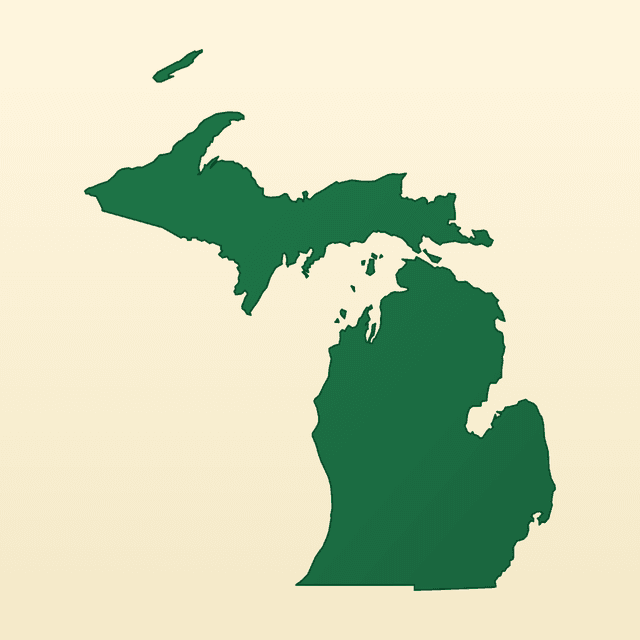
Michigan at a glance
Michigan Healthcare Landscape
What it actually looks like to run an outpatient clinic in Michigan
Michigan's healthcare market has gone through one of the most significant consolidations in the country. Beaumont Health and Spectrum Health merged in 2022 to form Corewell Health, now the state's largest employer with 22 hospitals and 300+ outpatient locations spanning east and west Michigan. Henry Ford Health and Ascension Michigan completed a large joint venture in 2024 that further reshaped metro Detroit. Trinity Health Michigan (IHA and its affiliates), University of Michigan Health (including the former Sparrow Health in Lansing), and McLaren Health Care round out the top five systems. Together these five control a very large share of the state's inpatient capacity and most of the outpatient employed physician base.
For independent clinic owners, the immediate implication is that employed physician supply has contracted dramatically. Every merger creates referral pattern shifts that are hard to see in your own P&L until it is too late. The second implication is that real estate, staffing, and technology spending by these systems sets the benchmark everyone else has to compete against, which has compressed margins for independent operators who have not rebuilt their financial reporting to keep up.
Michigan's economic fundamentals are less favorable than Sun Belt states. The state population has been roughly flat for over a decade. Cost of living is slightly below the national average. Wages for clinical staff run below California or New York but above the Southeast. The payer mix skews older and Medicare-heavier than fast-growing states, which affects both reimbursement realization and patient acquisition economics. Michigan Medicaid is delivered through 9 Michigan Health Plans (MHPs) (post-October 2024 rebid) with material plan-by-plan variation in realization. For clinics that have been operating here for 15+ years, nothing about the operating environment in 2025 resembles what they built the practice around.
Dominant outpatient specialties
Michigan orthopedics is one of the more active PE and system acquisition targets in the Midwest. Practices in Oakland County, Macomb, and west Michigan routinely get outreach, and the valuation gap between prepared sellers and unprepared ones is often measured in millions.
- Orthopedics and sports medicine, with strong independent groups across metro Detroit and west Michigan
- Cardiology, with a deep independent community cardiology base resisting system employment
- Dermatology and Mohs, with active PE consolidation across Oakland County and Grand Rapids
- Behavioral health and substance use, expanding under MDHHS-funded initiatives
- Dental and DSO-aligned dental groups, heavily present in metro Detroit and Grand Rapids
- Primary care, including direct primary care models growing in Ann Arbor and Grand Rapids
Major systems you compete against
Michigan's hospital landscape consolidated faster between 2022-2024 than in the prior decade combined. Independent clinics have to understand how that changed their referral economics, not just their competition.
Corewell Health
Formed from the 2022 Beaumont-Spectrum merger; Michigan's largest system with 22 hospitals and the state's largest ambulatory network.
Henry Ford Health
Detroit-based integrated system; expanded substantially through the 2024 Ascension Michigan joint venture.
Trinity Health Michigan
Multi-hospital Catholic system; includes IHA, one of the largest multispecialty physician groups in the state.
University of Michigan Health
Academic system anchored by Michigan Medicine in Ann Arbor; extensive regional expansion after the Sparrow Health affiliation.
McLaren Health Care
13-hospital statewide system with broad physician network; dominant in Flint, Lansing, and northern Michigan.
Tax & Regulatory
The Michigan rules your accountant should already know
Michigan's tax rules are stable but specific in ways that matter for clinic owners. The Corporate Income Tax and the City of Detroit tax each create obligations that out-of-state CPAs routinely miss.
Rates and thresholds move, often every legislative session. Treat what follows as a starting point for a conversation with your tax adviser rather than current filing guidance, and confirm anything you plan to act on against the state’s own published rates.
6.0% Corporate Income Tax (CIT)
Michigan imposes a 6% flat CIT on C corps. S corps and partnerships are not subject to CIT and pass income through to owners, who pay the state's 4.25% flat personal income tax. For most clinic structures, the S corp or PLLC election remains more tax-efficient than C corp status.
Source: Michigan Department of Treasury
Flow-Through Entity (FTE) Tax election
Michigan's FTE tax lets S corps and partnerships pay state income tax at the entity level, restoring federal SALT cap deductibility. For a Michigan practice with $300K+ of owner net income, this election typically produces $10K-$40K in annual federal tax savings. The election is retroactive-eligible and needs to be modeled annually.
City of Detroit income tax
Practices operating inside Detroit city limits owe City of Detroit income tax on net profits. The resident rate is 2.4%, the non-resident rate is 1.2%, and the corporate rate is 2.0%. For a Detroit-based clinic, this is a line item that should appear on every financial forecast but often does not because out-of-state CPAs are not set up to file Detroit returns.
Corporate Practice of Medicine
Michigan enforces the corporate practice of medicine doctrine. Physicians must own medical professional corporations or PLLCs, with ownership restricted to licensed physicians in the same field. MSO and friendly-PC arrangements for DSO/PE transactions are common but require careful structuring under LARA and Michigan Bureau of Professional Licensing oversight.
Certificate of Need (CON)
Michigan operates one of the more active CON programs in the country. ASC construction, major imaging equipment, and certain service line additions require CON approval through MDHHS. Timelines typically run 6-18 months. Expansion projects for Michigan clinics have to build CON timing into capital planning explicitly.
Source: Michigan MDHHS: CON
Local Market Dynamics
The market forces that show up on every Michigan P&L
Michigan's operating economics are shaped by a flat population, a concentrated system environment, and a payer mix that skews older than the national average. The practices that have adapted already have an advantage over the ones still running their 2019 playbook.
Post-merger referral disruption
The Corewell formation and Henry Ford-Ascension joint venture both changed referral patterns for thousands of independent practices. Primary care physicians who previously referred to independent specialists have increasingly been steered toward system-employed specialists inside the new larger networks. The financial fix is direct patient marketing and strategic hospital affiliations, but it starts with actually measuring where referrals come from and how that has changed over 24 months.
Michigan Medicaid Health Plans
Medicaid is delivered through 9 Michigan Health Plans (MHPs) (post-October 2024 rebid) covering different regions. Plan-level realization varies, and plans have been going through reprocurement cycles. For a clinic with meaningful Medicaid volume, plan-level contract tracking and realization analysis is the fix.
Aging population and Medicare mix
Michigan has one of the older median population profiles in the Midwest. For many clinics, Medicare represents 40-55% of patient volume. Medicare Advantage penetration is high and growing, which has material reimbursement implications compared to traditional Medicare. MA plan-by-plan realization is often where unexpected revenue gaps appear.
Flat population, uneven growth
Michigan's overall population has been roughly flat for over a decade, but Grand Rapids, Kent County, and Washtenaw County have grown while much of the rest of the state has declined. A clinic expanding into Grand Rapids is operating in a very different demand environment than a clinic in Saginaw or the Upper Peninsula.
How Sorso Helps Michigan Clinics
Healthcare-specialized accounting and CFO support, built for Michigan operating reality
Michigan clinics we work with are usually working through a referral landscape that looks nothing like it did three years ago. We focus on the financial reporting and strategic clarity that makes those decisions deliberate rather than reactive.
- •Monthly accounting with location- and provider-level P&Ls reconciled to your EHR and PM system.
- •Fractional CFO support for Michigan clinics in the $3M to $50M range, including post-Corewell referral-pattern mapping, Flow-Through Entity election planning, and system affiliation evaluation against Corewell, Henry Ford-Ascension, and Trinity.
- •Flow-Through Entity (FTE) tax election modeling and quarterly tracking.
- •Plan-level Medicaid Health Plan and Medicare Advantage realization analysis.
- •Specialty support for orthopedics, cardiology, dermatology, dental, mental health, and primary care practices.
Almost every Michigan practice we onboard is still running its 2019 referral and margin assumptions against a 2025 landscape where Corewell, Henry Ford-Ascension, and the nine-MHP Medicaid rebid have changed the board. Resetting the books to reflect that landscape is the first month of work.
Run your own numbers first
Before any of the Michigan specifics matter, it helps to know whether your practice is off-benchmark at all. These are free, need no email, and run in your browser.
Common questions from Michigan clinic owners
Our referrals have dropped since the Corewell merger. Is it in our heads?
Almost certainly not. System consolidations consistently shift referral patterns toward employed specialists inside the new network. Whether the effect on your practice is 5% or 25% depends on where you sit in the referral ecology and what relationships you have built directly with primary care physicians. The first step is measuring referral source data in your practice management system to quantify the shift, then building a response around direct patient marketing, non-system PCP relationships, and in some cases a strategic affiliation decision.
We are in Detroit and have never heard of the Detroit income tax. Do we owe it?
If your practice operates inside Detroit city limits, then yes, you almost certainly owe Detroit income tax on net profits attributable to Detroit operations. The corporate and non-resident rate is 1.2%. Failure to file is a surprisingly common error for practices that started with out-of-state CPA support. Back filings plus interest and penalties usually come out to real money on a $2M+ revenue practice.
We are considering joining Corewell or Henry Ford as an affiliated practice. How do we evaluate?
Evaluation comes down to three things: what the economic offer looks like on paper, what operational constraints come with it (referral rules, rate structure, governance), and what your independent trajectory looks like if you decline. We model all three explicitly for Michigan clients considering system affiliation. Most practices are surprised by the answer in both directions. Some should affiliate faster than they think. Some would be giving up more than they realize.
By specialty
Specialty-specific accounting in Michigan
Clinic finance in Michigan does not look the same across specialties. Benchmarks, payer mix, and cost structure differ materially.
Dental
Accounting and fractional CFO
Physical Therapy
Accounting and fractional CFO
Dermatology
Accounting and fractional CFO
Mental Health
Accounting and fractional CFO
Urgent Care
Accounting and fractional CFO
Med Spa
Accounting and fractional CFO
Chiropractic
Accounting and fractional CFO
Ophthalmology
Accounting and fractional CFO
Other Locations We Serve
We also serve outpatient clinics in
New Jersey
Healthcare accounting
Arizona
Healthcare accounting
Massachusetts
Healthcare accounting
Washington
Healthcare accounting
Colorado
Healthcare accounting
Virginia
Healthcare accounting
Maryland
Healthcare accounting
Tennessee
Healthcare accounting
See all states we serve — the full directory, with what is genuinely different in each one.
Ready to see how your Michigan clinic compares?
Take our 4-minute financial assessment. Find out what your books are not telling you.

Founder of Sorso and a CFA charterholder. Before Sorso, Stan spent 19 years in corporate finance at institutions including UniCredit and Société Générale — managing a $450M loan portfolio and making senior partner at a major mezzanine lender by 29 — then built a fractional CFO firm exclusively for outpatient healthcare clinics.